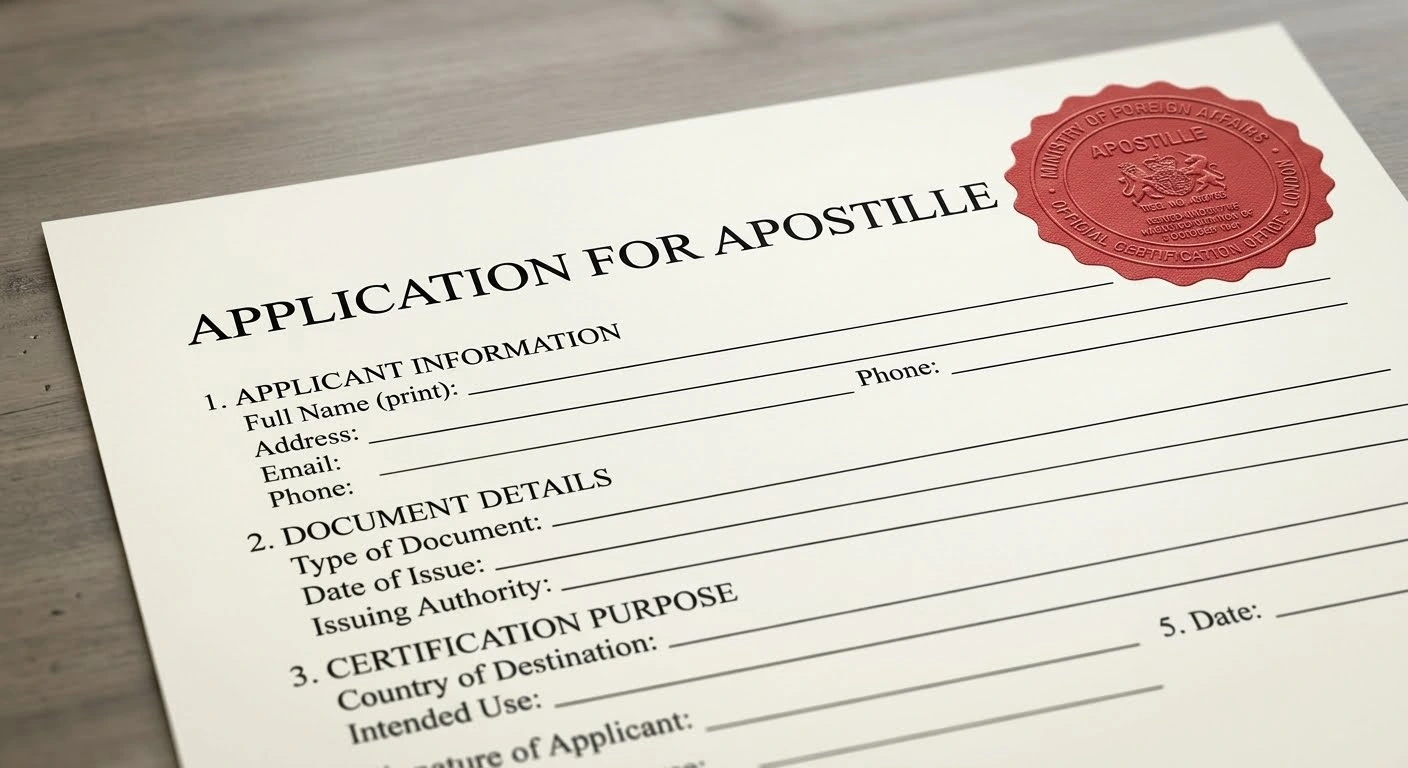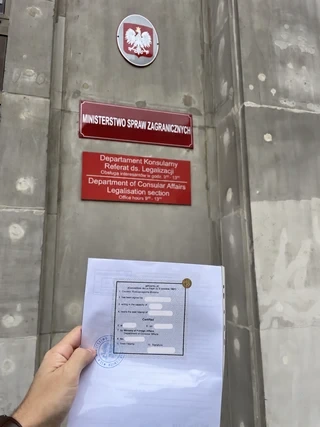
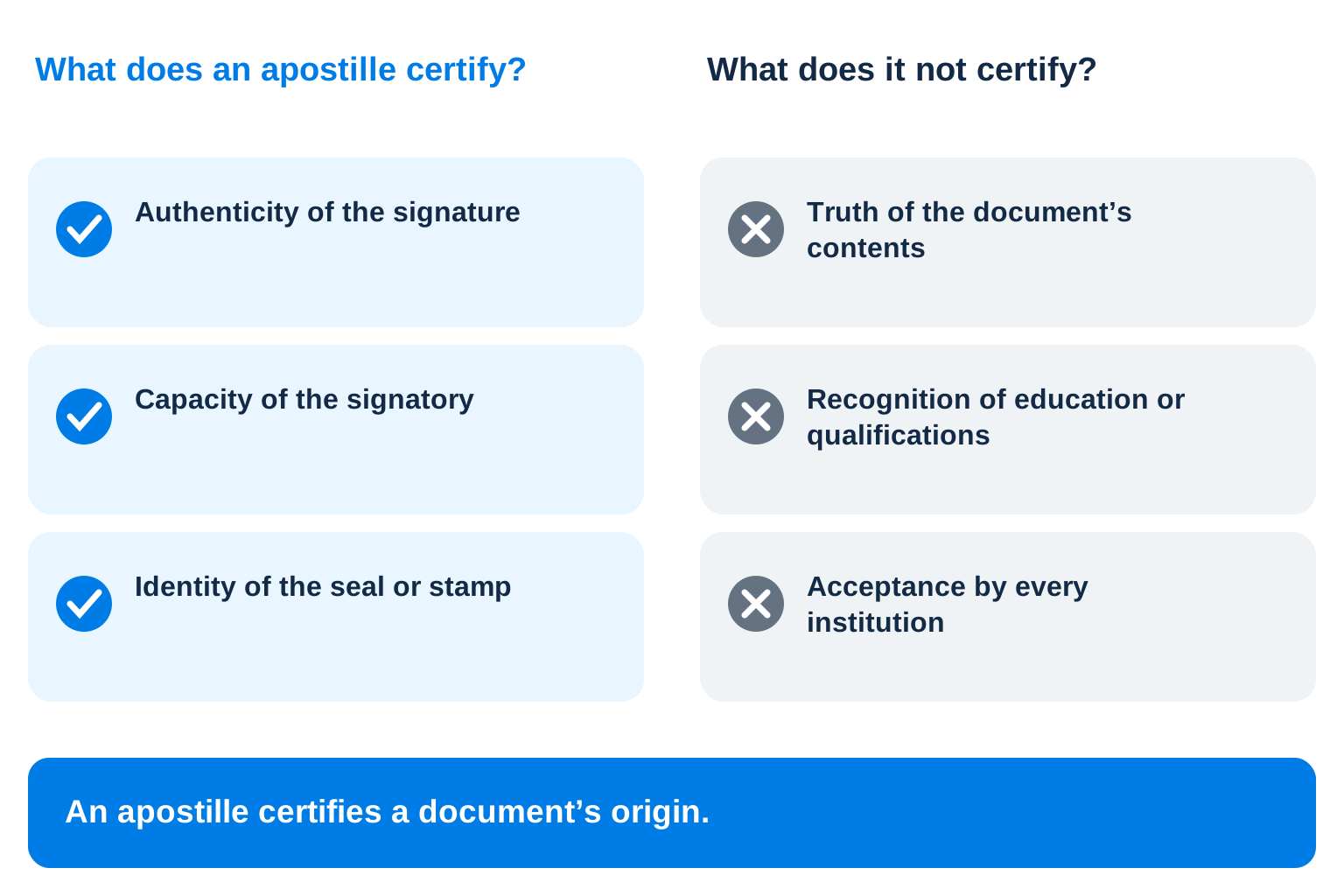
An apostille is an official certificate attached to a document for use abroad. It authenticates the signature, the role in which that person signed and any seal or stamp. The certificate can be placed directly on the document or on a sheet attached to it.
What does an apostille look like?
The heading reads “Apostille (Convention de La Haye du 5 octobre 1961)”, with ten numbered fields below it. The certificate goes on the document itself or on a separate sheet attached to it. That sheet is called an allonge.
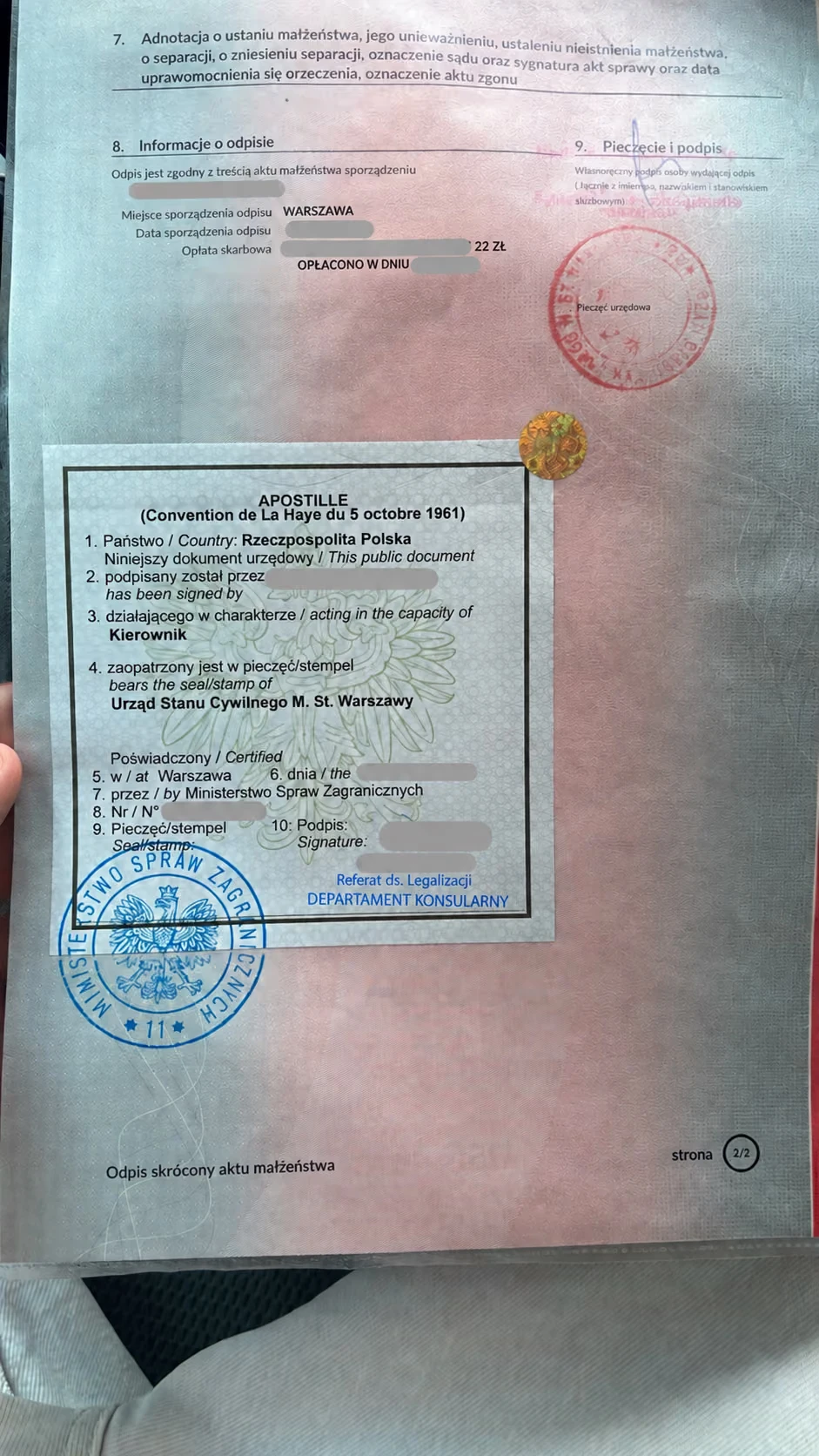
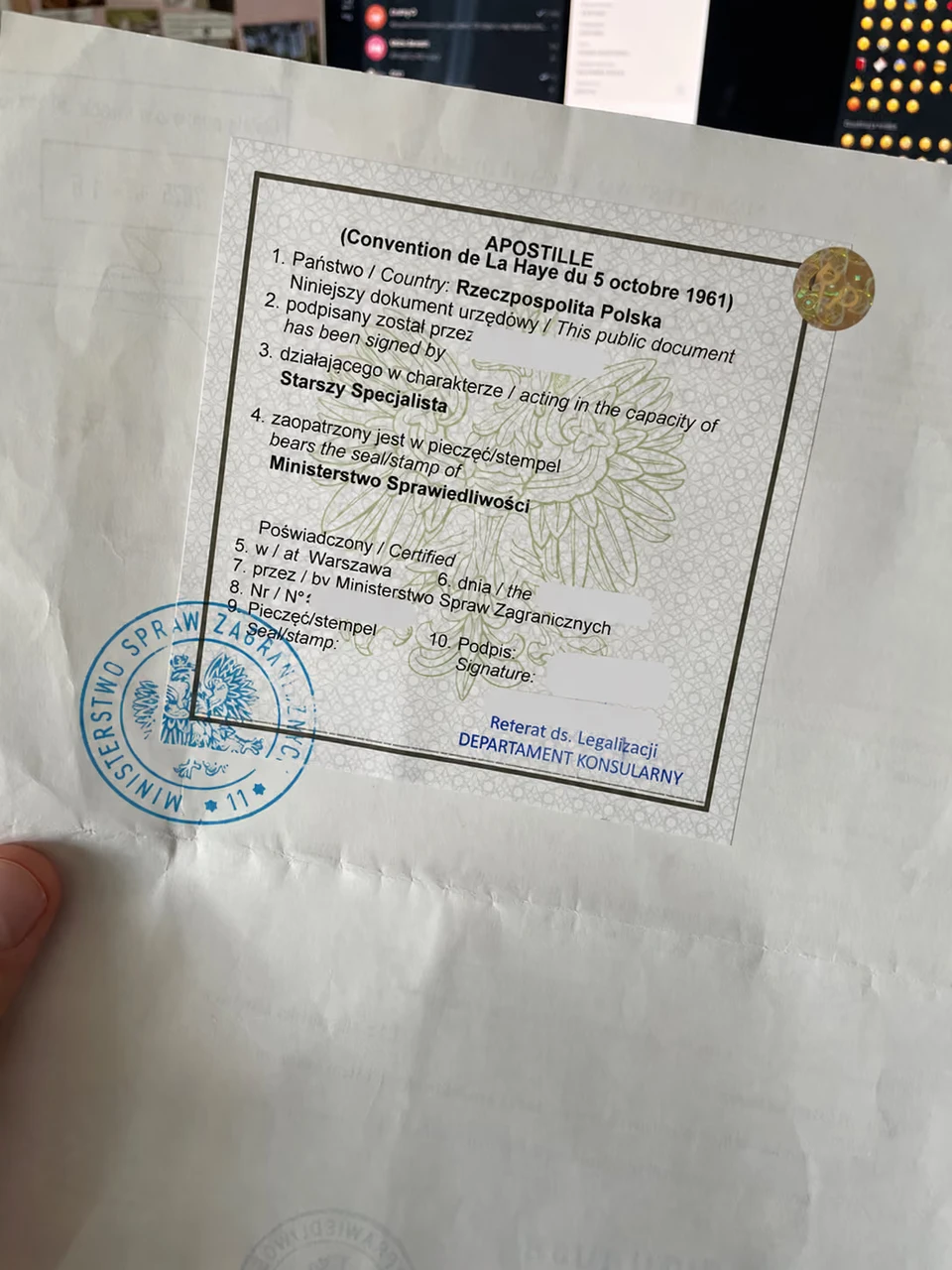
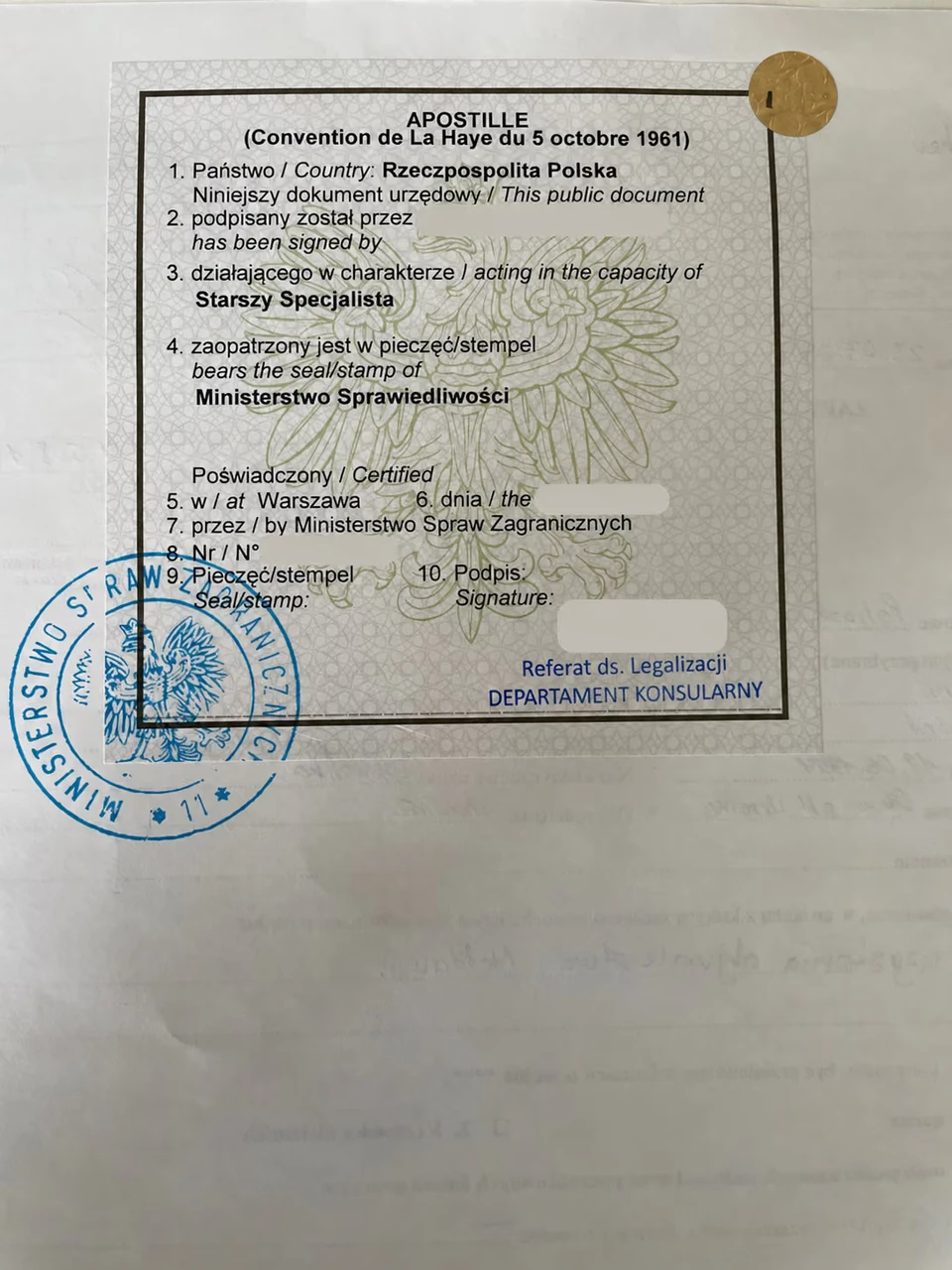
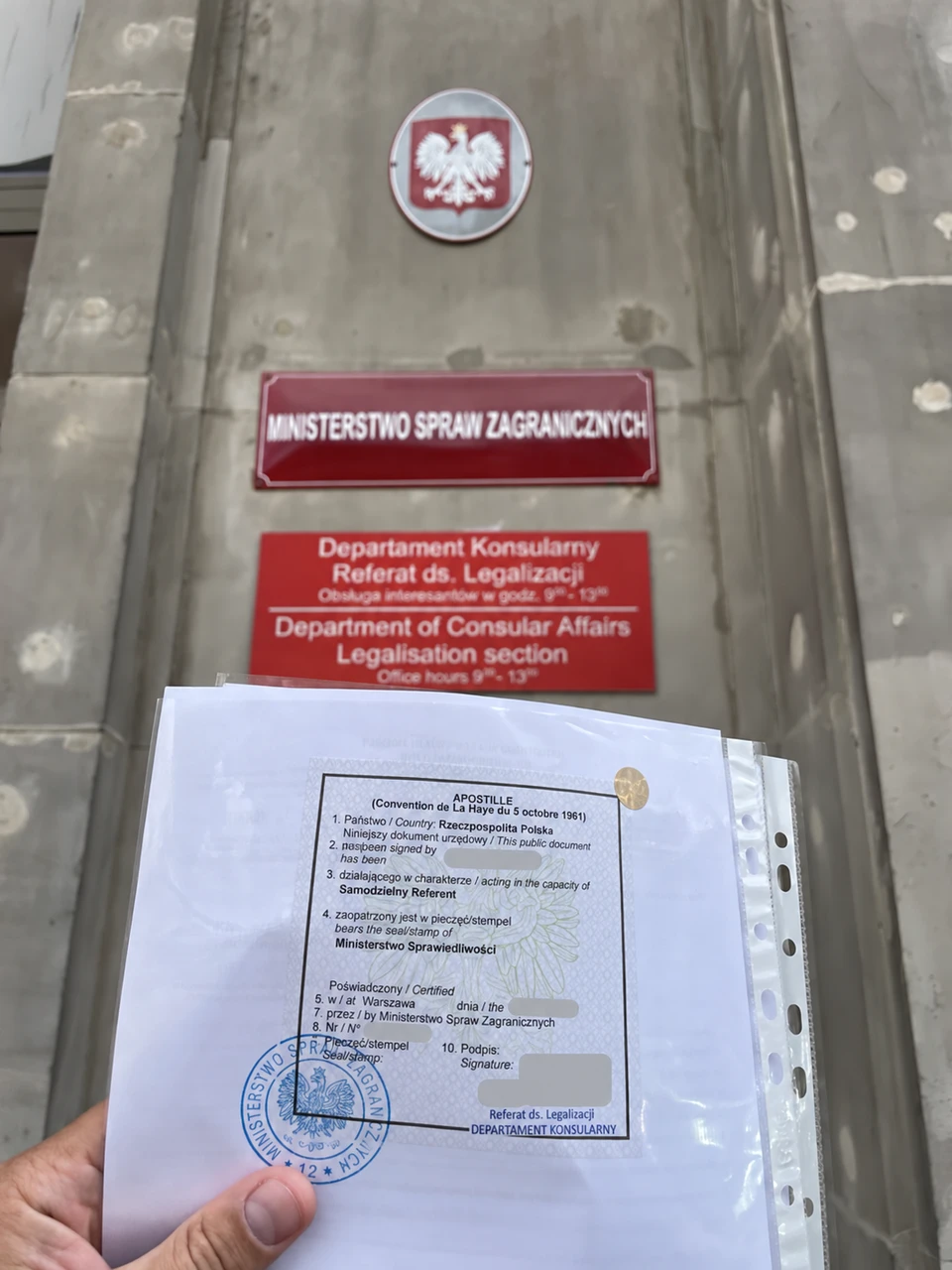
The official HCCH model groups the fields as follows:
- 1 to 4: the document’s country of origin, signatory’s surname, their capacity and details of the seal or stamp.
- 5 to 8: place and date of apostille issue, certifying authority and number.
- 9 and 10: the authority’s seal or stamp and the authorised official’s signature.
A printed sticker, handwritten official’s signature, seal and hologram are the features used by Poland’s MSZ. The design may look different in another country.
Look on the reverse as well as any attached sheets, and leave the apostille attached to the document. For an authenticity check, see how to verify an apostille using its number and issuing authority’s details.
What does an apostille authenticate?
The signature, the role in which the person signed and the seal or stamp are what an apostille authenticates. The institution receiving the document has a separate job: assessing what the document says and whether it meets the requirements of your procedure.
On a copy certified by a notary, the apostille may authenticate the notary’s signature and the role in which they signed. It does not authenticate the signature of the official who issued the original. Ask the recipient which version of your document needs the apostille.
University admission and recognition of a diploma still follow their own procedures. As HCCH explains, the apostille authenticates a document’s origin. Checking the contents or deciding the document’s legal effect falls outside that authentication.
When is an apostille needed?
For a public document being submitted abroad, the apostille procedure is available when the Hague Convention of 5 October 1961 applies between the two countries. You need to know where the document was issued, where it is going and whether the recipient requires this authentication.
The law or an international treaty may exempt the document from an apostille; the EU exemptions are covered below. Where neither the Convention nor an exemption applies, the route may be consular legalisation. The issuing and destination countries and the recipient’s requirements therefore need to be settled before you apply.
Which documents can receive an apostille?
Apostilles are issued for public documents and the official certifications covered by the Convention. These include documents from public authorities, notarial acts and official certifications of signatures on private documents.
Article 1 of the Convention defines these categories. The Polish Ministry of Foreign Affairs website gives examples of documents accepted for authentication:
- USC (Urząd Stanu Cywilnego) is Poland’s civil registry office. Its civil registry documents may include extracts from birth, marriage or death records and marital status certificates.
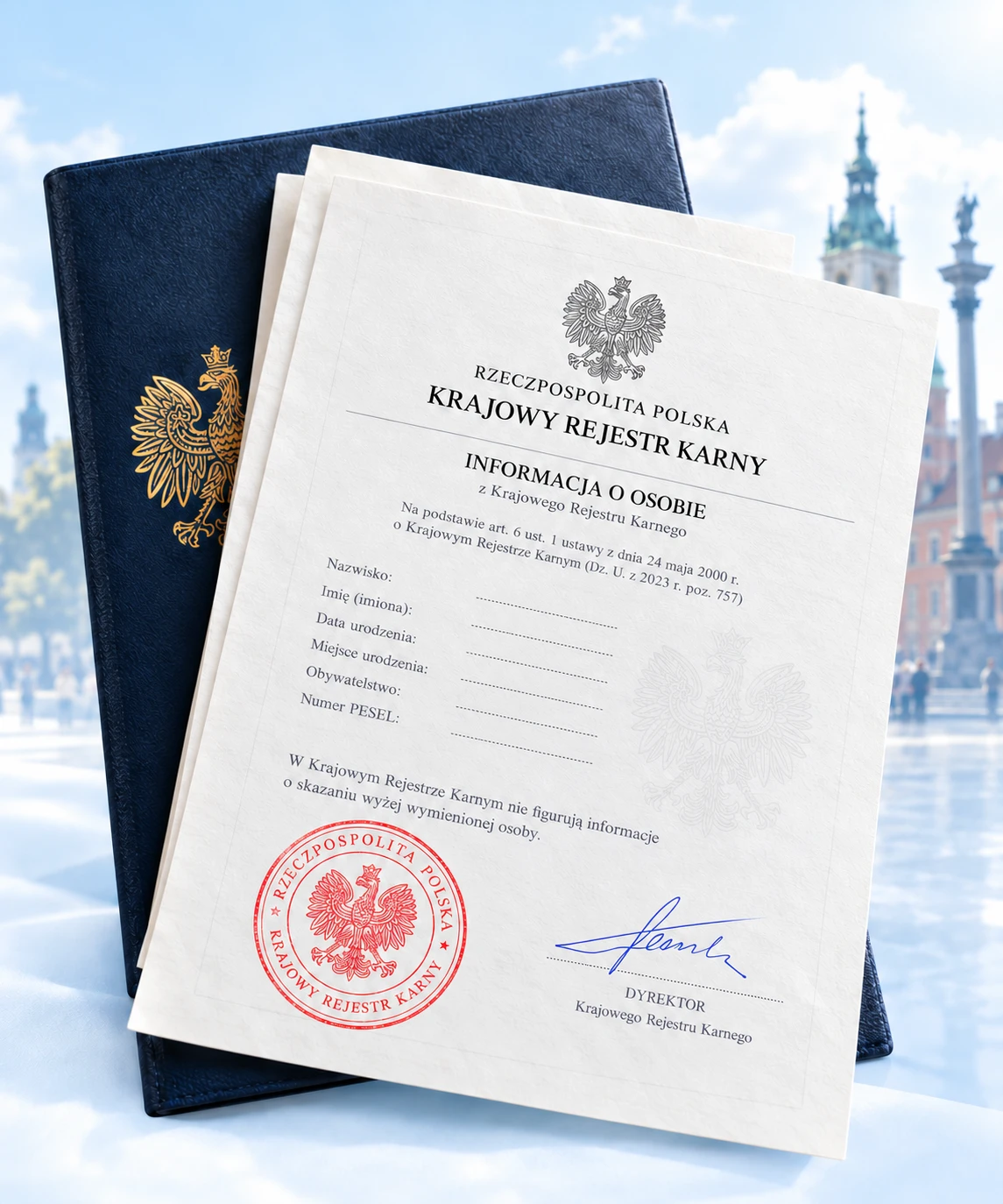
- Criminal record certificates can receive apostilles, as can court judgments and orders.
- Documents prepared by a notary include notarial powers of attorney.
- For education or qualifications, the examples range from school certificates and university diplomas to vocational training documents.
- Administrative decisions and registry documents are also included. One example is an extract from KRS, Poland’s National Court Register.
The document’s form matters. An original and an officially certified copy are not always interchangeable in a particular procedure, and an ordinary photocopy is insufficient for an apostille at Poland’s Ministry of Foreign Affairs. For a private document, an apostille may relate to official certification of a signature rather than the document’s contents.
When is an apostille unnecessary? EU exemptions and simplified procedures
Since 16 February 2019, Regulation (EU) 2016/1191 has exempted certain public documents from apostilles when they pass from one EU country to the authorities of another. It covers matters including birth, death, marriage, residence and citizenship. Whether your document is covered is the point to establish for your submission.
Diplomas and company documents fall outside this Regulation, so EU membership on its own does not settle whether you need an apostille. The European e-Justice Portal sets out which documents are covered. For how to use these rules, see Your Europe.
For some documents, a multilingual standard form can remove the need for a separate translation. An authorised body issues this form to accompany the document, so both stay together; the form does not replace it. If the receiving authority cannot fully understand the contents from the form, it may ask for a certified translation in exceptional cases.
Exemptions can also come from international treaties or the destination country’s laws. They leave the other requirements of the procedure in place, including any requirement for a translation. Before ordering, you need to know the basis for the apostille exemption and which language requirements still apply.
Who issues apostilles in Poland?
MSZ, Poland’s Ministry of Foreign Affairs, issues apostilles for Polish USC civil registry documents and KRK certificates. NAWA handles diplomas from Polish higher education institutions on its list, and the issuing OKE board handles examination board documents.
School, notarial and other documents follow separate rules. The relevant authorities and preparatory stages are listed in “Where to get an apostille in Poland”.
When is prior authentication required?
For a Polish notarial document, have the relevant regional court (sąd okręgowy) authenticate the notary’s signature before you submit it to MSZ. Court documents and certain medical or craft qualification documents also need preparatory steps.
Check the steps for your document type and the institution that issued it in the article on authentication before an apostille.
Apostille and translation: which comes first?
When the recipient needs a translation of the document together with its apostille, the translator needs the completed set. That means obtaining the apostille first. An existing translation or a certified copy needs its own agreed sequence.
The version of the document and the translation have to match what the recipient will accept. The article “Apostille before or after translation” explains the different situations. A Polish sworn translator’s credentials can be checked in the Ministry of Justice register.
How to obtain an apostille for a Polish document
To apply to MSZ, you need the original document, an application and proof of payment. If you are exempt from the state fee, prepare evidence of that entitlement instead. Complete any required prior authentication before you apply.
For an in-person visit, book through the official MSZ service and print the appointment confirmation to bring with you. A representative can also apply for you, or you can send the application by post. The in-person address is ul. Krucza 38/42, Warszawa; the postal application address is al. Szucha 23, 00-580 Warszawa.
NAWA and other authorities use their own applications and rules. Check which authority handles your document type, then follow its instructions.
Apostilles for foreign documents submitted in Poland
An apostille for a foreign original is issued by a competent authority in its country of origin. It is needed for submission in Poland if the Convention applies, the particular procedure requires authentication and no exemption covers the document.
You can find the authority in the HCCH list. Ask that authority about postal applications or representatives. Poland’s MSZ authenticates Polish documents; the holder’s residence and the original’s language do not change its country of origin.
If the Convention does not apply and there is no other exemption, legalisation involving a Polish consul may be required. Check the appropriate procedure with the Polish consular office serving the document’s country of origin.
You may also need a Polish translation of the foreign document. Having a copy or translation certified in Poland does not automatically replace an apostille on the foreign original. Before you arrange authentication abroad, ask the organisation receiving it in Poland which form of the document it needs and whether an exemption applies.
How much does an apostille cost?
At Poland’s MSZ, an apostille costs 60 zł for each document authenticated, unless a fee exemption applies. The rate is published on the ministry’s official page. This is a state fee, not the full cost of a service including translation or an intermediary’s help.
Separate documents are counted, not simply pages. For two documents at MSZ without an exemption, the fee is 120 zł. Check other institutions’ rules separately: the MSZ rate cannot automatically be applied to every procedure.
Fee exemptions may apply, including in certain education matters. As MSZ explains, the basis must be supported by documents, such as confirmation of admission or a valid school or student ID.
How long does it take?
At MSZ, an apostille can be issued during a pre-booked appointment if the document is prepared and needs no additional authentication. Postal applications are processed within 30 days of receipt by the ministry. Allow for delivery separately.
For NAWA, processing and checking a complete registered application takes 60 days. The agency warns that high application volumes may extend the wait.
Also allow for appointment availability, preparatory authentication and translation. The official processing period covers the authority’s work, not the document’s entire journey.
What does “miejsce na apostille” mean on a diploma?
“Miejsce na apostille” means “space for an apostille”. It marks where official authentication of a diploma for use abroad can be placed. Leave it empty if you do not need an apostille for your submission.
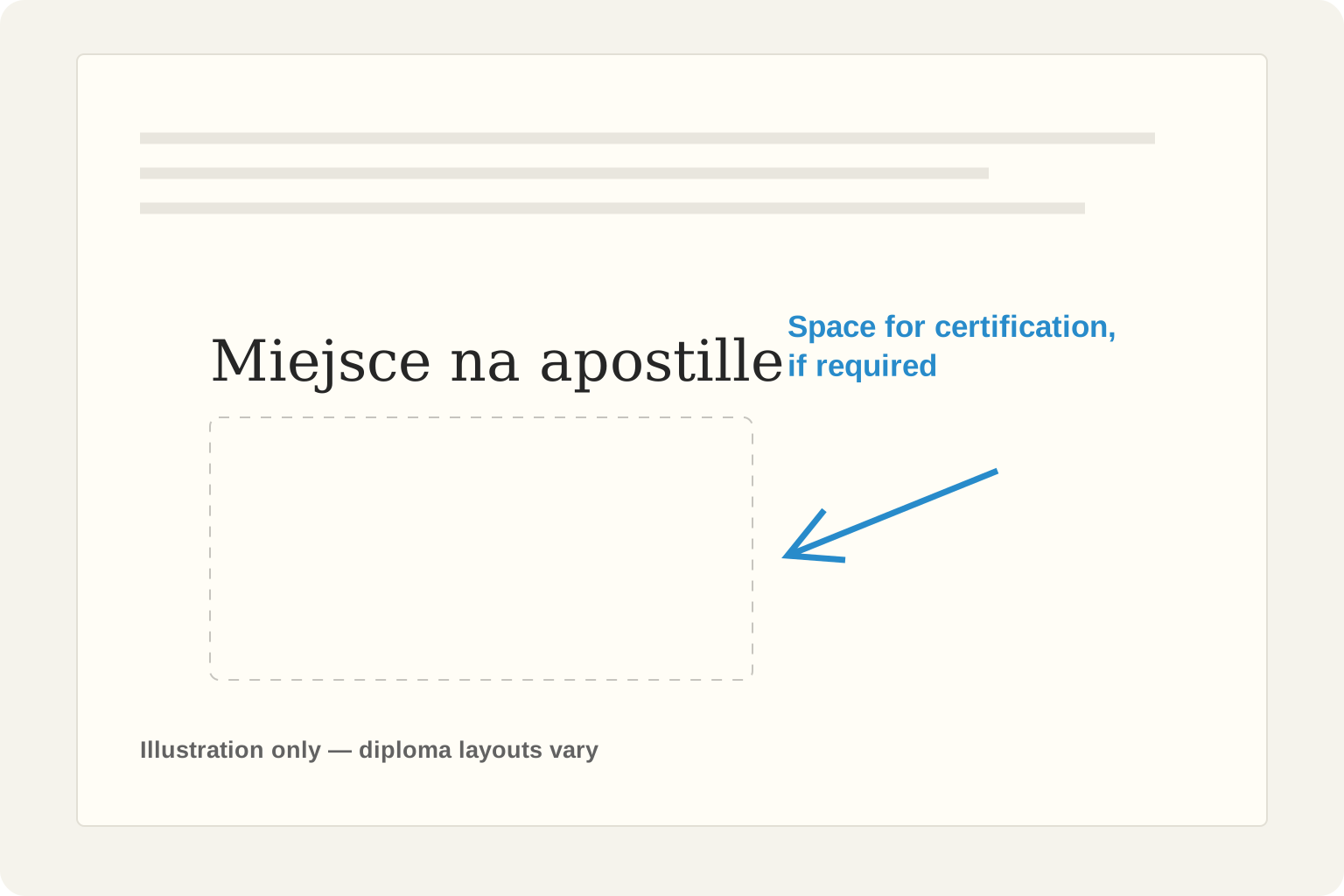
You can see this wording in a diploma model published by the University of Radom. You have to apply separately for an apostille; it is not added automatically when the diploma is issued. Check NAWA’s website for the documents from Polish higher education institutions that it is authorised to authenticate.
The space is for the apostille, so leave it for the authority to complete. You should not fill it in yourself before travelling. Whether you need to arrange an apostille depends on what the foreign university or authority asks for; if it requires one, prepare the documents for the application.
How long are an apostille and the document itself valid?
A correctly issued apostille has no expiry date. The recipient may set requirements for the underlying document’s validity or how recently it was issued. An apostille does not extend a document’s validity or update its contents.
As HCCH explains, an apostille cannot be rejected solely because of its age. The recipient may still require a more recent underlying document if the procedure’s rules provide for this.
For example, you may need a recent criminal record certificate even though the apostille on an older certificate remains valid. There is no universal three-month or six-month period for all documents.
The apostille stays with the document it authenticated and cannot be moved to a replacement. Before using the set again, find out whether the recipient needs a more recent document. A replacement document also needs a separate check on whether an apostille is required.
Preparing a document for submission
The receiving institution’s requirements determine what you need to prepare:
- Its answer should tell you whether to submit the original, a certified copy or a translation. You also need to know whether an apostille is required, which version needs it and how recently the document must have been issued.
- The country of issue and document type determine which authority to approach. Its instructions give the signatures and seals required and explain any prior authentication.
- For an apostille application, prepare the form and documents required by that authority. Submission and collection arrangements need to be agreed, with the state fee paid or evidence of an exemption ready.
- Where both the document and apostille need translating, the translator needs the whole completed set, including the reverse side and attached sheets. Obtain the apostille before handing it over. Where the translation itself needs the apostille, the translation must be prepared in the required form first.
The final check is against what the recipient asked for: names, dates and every required part of the set.
Translate Service can arrange document preparation and the apostille, as well as translation and delivery.