Get the apostille first if the institution wants it on the underlying document and needs the whole set translated. Then give the translator the document with all its endorsements. If the translation itself needs an apostille, have the translation prepared first.
Already have a translation? Check what the recipient still needs before you order the work again. You might need to have a later apostille translated, show the original or arrange a different form of certification for the translation. Ask why the existing set is not acceptable.
What needs the apostille: the original, a copy or the translation?
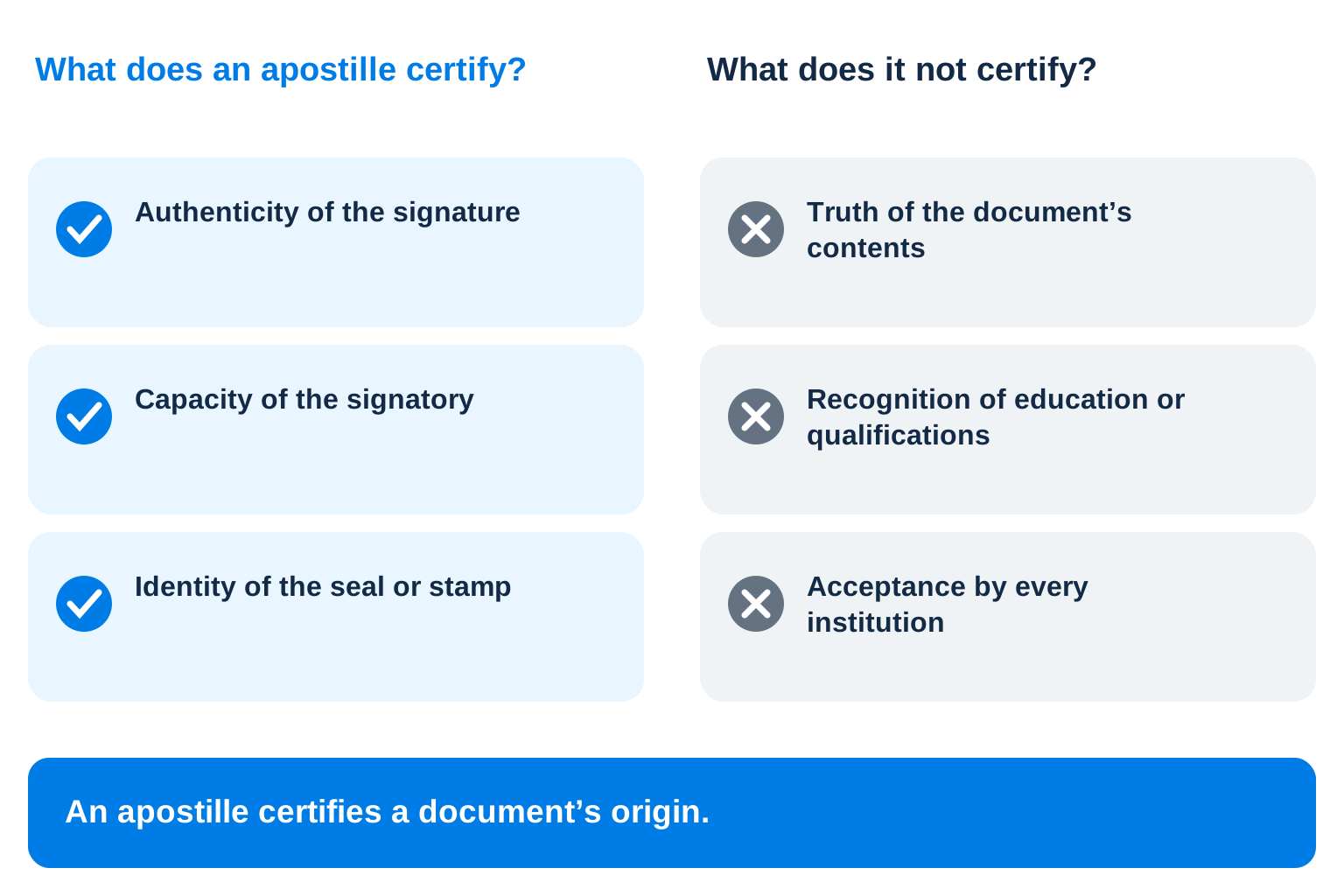
Under the Hague Apostille Convention, an apostille authenticates the signature on the document, the capacity in which the person signed and any applicable seal or stamp. The signature or certification being authenticated changes with the document you present:
On the underlying document, it authenticates the issuing authority’s signature and seal.
On a notarised copy, it covers the notary’s certification of that copy.
On a certified translation, it authenticates the relevant signature or statement used to certify the translation.
Ask the institution what it means by a “document with an apostille”. It will not necessarily accept one of these versions in place of another. You could otherwise pay for authentication that is correctly issued but does not meet the requirements of your procedure.
What to check before ordering an apostille and translation
A written reply from the receiving institution gives you requirements for your own procedure before you pay for an apostille and translation. Ask it to confirm:
whether this document needs an apostille for the submission;
where the apostille must go: on the underlying document, a notarised copy or the translation;
the language of the translation and who must certify it;
which parts must be translated, including the main text, attachments, reverse side and additional endorsements;
how to submit the result: on paper or as an electronic file, and as an original or a copy.
A Russian-language document could have been issued in several different countries, so its language does not identify the procedure. Your enquiry needs to say where the document came from and where you will use it.
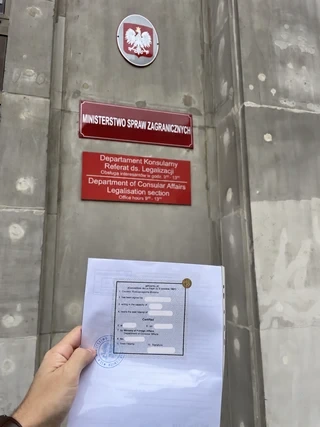
Apostille and translation requirements need separate answers because some documents and submissions are exempt from authentication. The Polish Ministry of Foreign Affairs instructions are among the sources that describe these exemptions.
Translating a document that needs an apostille
An apostille on the underlying document becomes part of the set the translator works from. When the recipient needs that whole set translated, the order is:
Prepare the version of the document the recipient requires.
Complete any prior authentication required for it, followed by the apostille.
Hand the completed document to the translator with every endorsement and attachment.
Having the certificate translated early leaves the later apostille and endorsements outside the translated text. You then need to agree how to add them. Waiting until the apostille is in place lets the translator cover the complete set without that extra work.
Send the full set when ordering sworn document translation: the document, apostille, reverse side and attachments.
How to get an apostille on a translation
Have the translation prepared in the form the recipient needs, then apply for its apostille. Before giving the translator the job, confirm who must prepare the translation and whose signature the apostille is to authenticate.
A photocopy of a sworn translation cannot receive an apostille at Poland’s Ministry of Foreign Affairs. Sworn translations have their own category in the ministry’s official instructions.
The underlying document may need its own apostille as well. When the recipient asks for both, arrange each procedure separately.
Give the translator the recipient’s exact wording and the destination country. They also need to know whether the final set must include translations of endorsements added during authentication.
The requirements and application steps for a Polish sworn translation are set out on the document translation apostille page.
When is a notarised copy with an apostille suitable?
On a notarised copy, the apostille relates to the notarial certification. It does not authenticate the original issuing authority’s signature. Before arranging a copy and its apostille, you therefore need the recipient’s agreement to use that form.
The Polish Ministry of Foreign Affairs’ frequently asked questions describe a case involving certification that a copy matches the original. Acceptance of the copy has to be confirmed in the destination country.
Before visiting a notary, you could ask:
Will you accept a notarised copy with an apostille authenticating the notarial certification? Or does the apostille have to be on the underlying document?
Five situations: what to do about the apostille and translation
Find your situation in the table. It shows what to clarify with the recipient and translator before placing another order.
What to do with your existing document and translation
What you have
What to establish
Next step
Underlying document without an apostille or translation
Whether an apostille is required, and on which document
Confirm the requirements, then agree the order of steps
A completed translation, followed by an apostille on the document
Whether the new endorsements must be included and a supplement is acceptable
Discuss the arrangements with the translator and recipient
A translation made from a scan or copy
Whether the institution accepts that source for the translation
Check the certification statement and the requirement to present the original
A notarised translation from another country
Whether the language, translator and certification method are acceptable
Show the recipient your existing set before ordering again
A requirement for an apostille on the translation
Which translation is required and whose signature is authenticated
Agree a separate procedure for the translation
When contacting an agency about an existing translation, explain what has changed. Show the translation and the institution’s requirement to discuss the work still needed.
Must the document be translated again after an apostille?
Show the translator your existing translation alongside the document with its new apostille. It may be possible to keep the text and add a supplement for the missing part. Agree with the translator how that part will be prepared before ordering the translation again.
For newly added endorsements, the supplement needs a clear link to the original translation, and the recipient must accept them together. A translation of the added sheet on its own may not meet that requirement.
You may need a different translation when:
the institution requires a different form of translation certification;
the translation was made from a copy but the institution needs one made from an original shown to the translator;
you now have a replacement for the underlying document;
the translation is in a language the recipient does not accept, or required parts have been left out.
“The translation is unsuitable” does not explain what needs fixing. Get the recipient’s specific objection and show it to the translator so you can agree the changes.
Keep the certified translation intact while this is being resolved. Do not add your own text, replace pages or attach extra sheets yourself.
Checking whether a translation was made from a scan or an original
You can send an agency a scan for a quotation. However, if the institution requires a translation made from an original presented to the translator, this must be reflected in the completed translation. Check which source material is identified in your translation’s certification statement.
Article 18(2) of Poland’s Act on the Profession of Sworn Translator requires the translation to say whether it was made from an original, a translation or a copy. It must also state the details of any certification of that source.
Acceptance of a translation from a scan is up to the institution receiving it. The source named in the certification statement must match what the institution requires. If it asks to see the original and wants a translation made from that original, show the translator those instructions and discuss what to do next.
You can start an enquiry with images of the documents and a description of what you need. Before the final translation is prepared, agree whether you will need to show the original.
Will a foreign notarised translation be accepted in Poland?
Before paying for a new translation in Poland, show the receiving institution the notarised translation you already have from abroad. It needs to see who translated the document and what the notary certified.
Polish sworn translators prepare and certify translations within their authorisation under Polish law. This is what the term tłumaczenie przysięgłe refers to in Poland. The translator, language or certification used in another country may be different.
Find out:
whether the institution accepts the language of the translation you have;
whether its certification method is acceptable;
whether a Polish sworn translator must prepare the translation;
whether the institution needs to see the original;
whether every part it requires has been translated.
If the translation is rejected, get the specific reason before commissioning more work. A correction to the certification or the way the documents are presented may be enough. In other cases, a new translation will be needed.
Must the apostille itself be translated?
Recognition of the apostille and translation of the underlying document are separate requirements. Under the Hague Convention, an apostille does not need a translation in order to be recognised. The institution may still require the document to be translated under the rules for your submission.
Paragraphs 304 and 305 of the HCCH Apostille Handbook say that neither the apostille’s language nor the absence of a translation is a reason to reject it. Advice to translate every apostille is therefore too broad; it also does not settle what translation is needed for the underlying document.
When the recipient asks for all endorsements to be translated with the document, clarify exactly what it wants and the basis for that requirement. If it is demanding a translation to recognise the apostille itself, ask for an explanation in light of the Convention.
Agreeing apostille and translation requirements
Explain which document you plan to submit and what you already have. Adapt this enquiry to your situation:
Dear Sir or Madam,
I am preparing [document type] for [procedure]. It was issued in [country] by [authority].
I currently have [the original / a certified copy / a translation]. The translation was made from [the original / a copy / a scan, as stated in its certification statement]. An apostille [has already been issued / has not yet been obtained].
Could you help me confirm the following before I arrange any further work?
Do I need an apostille for this document in this procedure?
Should it go on the underlying document, a notarised copy or the translation?
What language should the translation be in, and who must certify it?
Please tell me which pages, attachments and endorsements I should have translated.
How should I submit the complete set?
If the apostille is added after the translation is complete, would you accept a supplement, or would I need a new translation?
Please provide a link to the applicable requirements if possible.
Thank you.
Give the reply to the translator before work starts. If the document, institution or purpose of submission changes later, check the requirements again.
What to check before ordering an apostille and translation
Before ordering, make sure you have established:
Where and for which procedure you are submitting the document.
Whether an apostille is required and which document must bear it.
Which translation language is needed and who must certify it.
Whether the original is needed to complete the order.
Which pages and endorsements must be translated.
Whether an existing translation can be used or supplemented.
Help arranging translation of your document set
You can ask Translate Service for advice on an existing translation. Show us the document, translation and recipient’s requirements. We will establish what still needs translating and agree the arrangements.
We will decide whether to translate only the apostille or the full set after clarifying the requirements for your submission.
About the author
Karolina Bałabon
Sworn translator of Russian
Working in translation since 2000, she has been a sworn translator of Russian since 2006. She graduated in applied linguistics from the University of Warsaw.
She specialises in legal, court and notarial translation. She works with Russian, Ukrainian, Polish and English, and deals with apostilles, legalisation and the preparation of foreign documents for use in Poland.